Compound Interest Calculator
The Compound Interest Calculator below allows you to compare or convert interest rates across different compounding periods. For actual compound interest calculations, please use our Interest Calculator.
Related : Interest Calculator | Loan Calculator | Investment Calculator
What is compound interest?
Interest is the cost associated with borrowing money, or more precisely, the compensation a lender receives for providing funds to a borrower. When interest is charged, the borrower typically pays a certain percentage of the principal, which is the original amount borrowed. Interest plays a fundamental role in finance and economics, influencing loans, savings, investments, and overall financial decision-making. Broadly, interest can be classified into two main types: simple interest and compound interest.
Simple interest is calculated solely on the principal amount and does not take previously earned interest into account. It is usually expressed as a fixed percentage of the principal over a specified period of time. Calculating simple interest is straightforward: multiply the principal by the interest rate and the number of time periods the loan or investment remains active. For example, if an individual borrows $100 from a bank at a simple interest rate of 10% per year for two years, the total interest owed at the end of the loan period would be:
Although simple interest is easy to understand and calculate, it is rarely used in real-world financial products today. Most modern loans, savings accounts, and investments rely instead on compound interest, which better reflects how money grows or accumulates over time.
Compound interest differs from simple interest in that it is calculated not only on the original principal but also on the interest that has already been added to the balance. In other words, interest is earned on interest. Using the same example of a $100 loan at a 10% annual compound interest rate over two years, the interest earned in the first year would be:
At the end of the first year, the loan balance becomes $110, which includes both the original principal and the interest earned. During the second year, interest is calculated on this new balance rather than on the original $100. As a result, the second year’s interest would be:
After two years, the total compound interest amounts to $21, compared to only $20 under simple interest. While this difference may appear small at first, it becomes increasingly significant as the interest rate rises or the investment period lengthens.
Because compound interest allows earnings to generate additional earnings, growth accelerates over time in a manner similar to a snowball rolling downhill and growing larger. This exponential effect means that lenders and investors can benefit substantially from long-term compounding. The longer the money remains invested or loaned at a compound rate, the greater the potential for growth.
To illustrate the power of compound interest in investing, consider a young individual who invests $1,000 in the stock market at age 20, earning an average annual return of 10%, which is approximately the long-term average return of the S&P 500 since the 1920s. By age 65, when the individual retires, that initial investment would grow to about $72,890 roughly 73 times the original amount without adding any additional contributions.
However, while compound interest is a powerful tool for building wealth, it can also have negative consequences for borrowers. When applied to outstanding debt such as credit cards or long-term loans, compound interest can significantly increase the total amount owed over time. Delaying payments or extending debt repayment periods can cause interest charges to grow rapidly. For this reason, compound interest is often described as a double-edged sword capable of creating wealth when managed wisely, but equally capable of magnifying financial burdens when debt is left unchecked.
Different compounding frequencies
Interest can compound according to a variety of frequency schedules, depending on the terms of a loan or investment agreement. While interest may technically compound at any interval, the most common compounding frequencies are annually and monthly. The frequency at which interest is compounded plays a critical role in determining the total amount of interest paid on a loan or earned on an investment. In general, the more frequently interest compounds, the greater the total interest accumulated over time.
Compounding frequency directly affects how interest is calculated and added to the balance. For instance, consider a loan with a stated annual interest rate of 10% that compounds semi-annually. Because interest is applied twice per year, the annual rate is divided by two, resulting in a periodic rate of 5% every six months. If $100 is borrowed, the interest charged during the first half of the year would be:
After the first six months, the balance becomes $105. During the second half of the year, interest is calculated on this increased amount rather than on the original principal. As a result, the interest for the second period would be:
When the two periods are combined, the total interest paid over the year equals $10.25. This means that a nominal 10% interest rate compounded semi-annually is effectively the same as a 10.25% interest rate compounded annually, even though the stated annual rate remains 10%. This difference arises solely because interest is allowed to compound more than once during the year.
Different financial products use different compounding conventions. Savings accounts and Certificates of Deposit (CDs) typically compound interest on an annual basis, allowing earnings to build steadily over time. In contrast, mortgage loans, home equity loans, auto loans, and credit card balances usually compound interest monthly, which can significantly increase the total amount of interest paid over the life of the loan.
Interest rates that compound more frequently often appear lower when expressed in periodic terms. Because of this, lenders commonly advertise monthly interest rates instead of annual rates. For example, a mortgage with a stated interest rate of 6% per year translates to a monthly rate of 0.5%. While this monthly figure may seem modest, monthly compounding causes the effective annual interest rate to rise. After compounding over 12 months, the actual annual interest amounts to approximately 6.17%, not the advertised 6%.
Understanding compounding frequency is essential for accurately comparing financial products. Two loans with the same stated interest rate can result in very different costs depending on how often interest is compounded. This is why converting interest rates between different compounding schedules provides a clearer picture of the true cost of borrowing or the true return on savings.
Our compound interest calculator above is designed to make these comparisons easy and accurate. It supports conversions across a wide range of compounding frequencies, including daily, bi-weekly, semi-monthly, monthly, quarterly, semi-annual, annual, and continuous compounding (where interest compounds an infinite number of times per year). By using this tool, users can better understand how compounding frequency impacts interest growth and make more informed financial decisions.
Compound interest formulas
The calculation of compound interest often involves mathematical formulas that may appear complex or intimidating, especially for those who are not familiar with financial mathematics. Because compound interest depends on multiple variables such as the interest rate, compounding frequency, time horizon, and principal amount even small changes in one factor can significantly affect the final result. Performing these calculations manually can be time-consuming and increases the risk of errors, particularly when interest compounds multiple times per year.
To address these challenges, our compound interest calculator provides a simple, accurate, and user-friendly solution. It automates the entire calculation process, allowing users to instantly determine interest growth without needing to understand or apply complicated formulas. Whether you are estimating investment returns, comparing loan costs, or planning long-term financial goals, the calculator delivers fast and reliable results with minimal effort.
However, for users who wish to explore the mechanics behind compound interest in greater detail, understanding the formulas can be both insightful and empowering. Reviewing the formulas helps clarify how interest accumulates over time and illustrates the mathematical relationship between principal, rate, time, and compounding frequency. This deeper understanding can be especially valuable for students, investors, and anyone interested in strengthening their financial literacy.
The formulas provided below break down the compound interest calculation step by step, showing exactly how each variable contributes to the final amount. By examining these formulas, readers can better grasp why compound interest grows exponentially and how different compounding schedules influence the overall outcome.
continuous compound interest formula
The continuous compound interest formula represents a special case of compound interest in which interest is compounded an infinite number of times per year. Instead of being applied at specific intervals—such as monthly, quarterly, or annually interest accrues continuously, meaning it is added to the principal at every possible moment. This results in the maximum possible growth for a given interest rate and time period.
The formula for continuous compound interest is:
Where:
- A is the final amount after interest,
- P is the initial principal (starting amount),
- r is the annual interest rate expressed as a decimal,
- t is the time in years,
- e is Euler’s number (approximately 2.71828), a mathematical constant that naturally arises in growth processes.
Continuous compounding is derived from the standard compound interest formula by increasing the compounding frequency indefinitely. As the number of compounding periods per year grows larger, the formula approaches the continuous compounding limit, which is why the exponential function is used. Although continuous compounding is not as common in everyday financial products, it is frequently used in theoretical finance, economics, and advanced investment modeling.Model investment growth
One of the key advantages of continuous compounding is that it provides a precise and elegant way to model natural growth. It is often applied in situations involving long-term investments, bonds, and certain financial instruments where accurate growth projections are essential. Because interest is constantly added to the balance, continuous compounding produces slightly higher returns than even daily compounding at the same nominal interest rate.
In practical terms, understanding the continuous compound interest formula helps investors and borrowers appreciate the full impact of compounding over time. While most real-world accounts compound at discrete intervals, continuous compounding serves as an important benchmark for comparing interest rates and evaluating the theoretical maximum return on an investment.
Basic compound interest
The basic formula for compound interest is as follows:
At = A0(1 + r)n
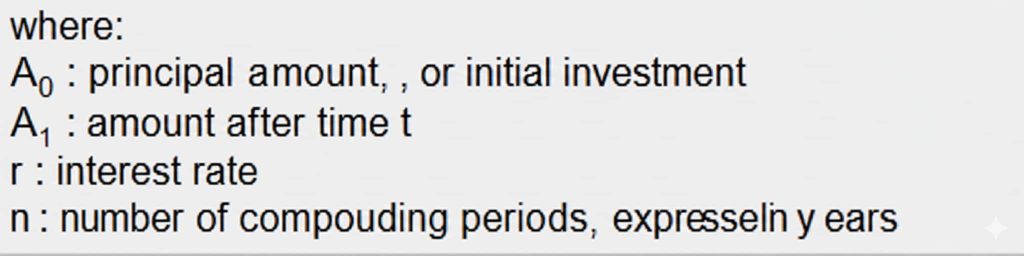
Consider the following example: a depositor opens a savings account with an initial deposit of $1,000. The account offers an annual percentage yield (APY) of 6%, compounded once per year, for a period of two years. Using the compound interest formula mentioned above, the total balance at the end of the two years can be calculated as follows:
This means that after two years, the account balance grows to $1,123.60, including both the principal and the interest earned.
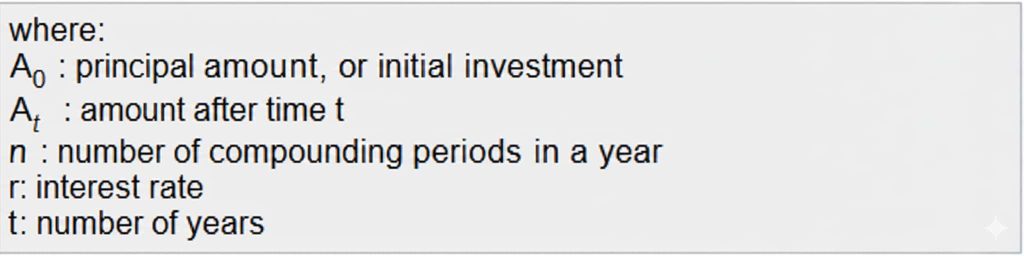
If the account compounds more frequently—such as monthly, weekly, or daily—the interest calculation changes to reflect the shorter compounding periods. In such cases, prospective depositors should use the generalized compound interest formula:
Where:
- At is the amount at maturity,
- A0 is the initial deposit,
- r is the annual interest rate,
- n is the number of compounding periods per year, and
- t is the total number of years.
Using this formula, one can calculate exactly how much the deposit will grow under any compounding frequency, providing a flexible tool for comparing different savings options.
Suppose the $1,000 in the savings account from the previous example earns a 6% interest rate, compounded daily. This corresponds to a daily interest rate of:Daily rate=3656%=0.0164384%
Using the standard compound interest formula, the total account value after two years can be calculated as:
Therefore, a $1,000 deposit in a two-year savings account with a 6% interest rate compounded daily will grow to $1,127.49 at the end of the period.
Continuous compounding
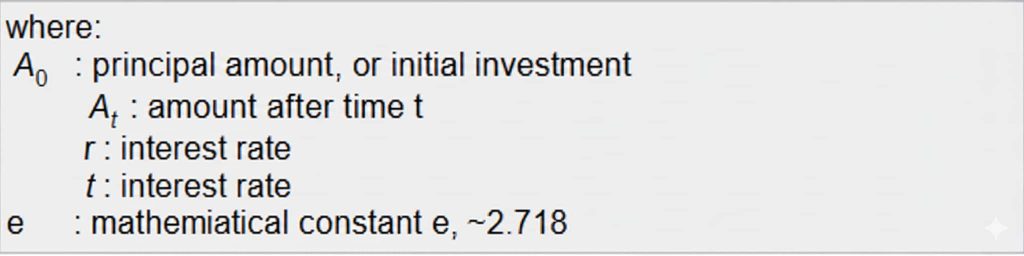
Continuous compounding represents the theoretical maximum interest that can be earned over a given time period. The formula for continuous compounding is:
where A0 is the initial principal, r is the annual interest rate, and t is the time in years.
For example, let’s calculate the maximum interest that can be earned on a $1,000 savings account over two years using continuous compounding:
These examples illustrate that the more frequently interest is compounded, the more is earned. However, beyond a certain compounding frequency, the additional gains become minimal, especially for smaller principal amounts.
Rule of 72
The Rule of 72 is a simple, widely used shortcut for estimating how long it will take an investment to double in value, assuming a fixed annual rate of return with compounding. It provides a quick, intuitive way to assess the potential growth of savings, investments, or other financial assets without performing complex calculations. This rule works best for investments with reasonably stable interest rates and is most accurate for rates that fall within a moderate range, typically between 4% and 15% per year.
To use the Rule of 72, simply divide the number 72 by the annual rate of return expressed as a percentage (not a decimal). The result gives an approximate number of years required for the initial investment to double.
For instance, if you invest $100 at an annual return of 8%, the calculation would be:
This means that, under these conditions, your $100 investment would roughly grow to $200 in nine years. It is important to note that in this calculation, the “8” represents 8%, so you should not convert it to decimal form (e.g., 0.08). Using the decimal would give an incorrect result.
While the Rule of 72 is a convenient and easy-to-remember tool, it is only an approximation. The actual doubling time can differ slightly depending on the exact compounding method, the rate of return, and market fluctuations. Nevertheless, it remains a valuable tool for investors, students, and financial planners to quickly gauge the effects of compounding over time and make rough comparisons between different investment opportunities.
By providing a fast estimate of growth, the Rule of 72 encourages better financial planning and demonstrates the power of compounding interest over the long term, highlighting how even modest returns can significantly increase wealth over decades.
History of Compound Interest
Historical records indicate that two of the earliest known civilizations, the Babylonians and Sumerians, were among the first to experiment with the concept of compound interest around 4,400 years ago. Their approach, however, was quite different from the standardized methods used in modern finance. In their system, interest was calculated on 20% of the principal until it equaled the original amount. Once this threshold was reached, the accumulated interest would be added to the principal, effectively allowing the investment to grow further. While rudimentary, this practice laid the groundwork for the concept of compounding.
Throughout history, simple interest was generally recognized as legal and socially acceptable. In contrast, many societies viewed compound interest with suspicion and even condemned it as usury, or excessive and immoral lending. For example, Roman law prohibited the charging of compound interest, and religious doctrines from both Christianity and Islam referred to it as sinful. Despite these restrictions, lenders continued to experiment with and use compound interest during the medieval period, gradually finding ways to make it a more accepted financial practice. The development of compound interest tables in the 1600s further facilitated its adoption, providing a practical tool for calculating growth over multiple periods.
A major turning point in the understanding of compound interest came with the discovery of Euler’s Constant, denoted as e. This mathematical constant represents the theoretical limit of growth achievable through continuous compounding. The story begins with Jacob Bernoulli in 1683, who, while studying compound interest, observed a fascinating pattern: the more frequently interest was compounded within a fixed time period, the faster the principal grew. Bernoulli realized that it did not matter whether the intervals were measured in years, months, or even days—the cumulative effect of more frequent compounding consistently increased returns for the lender.
Bernoulli also noticed that as the compounding intervals became infinitely small, the growth of the principal approached a fixed limit. This limit, he concluded, described the relationship between the ultimate growth of an investment and the interest rate when compounding is continuous.
Later, Leonhard Euler built upon Bernoulli’s work and calculated the constant with greater precision, determining that it was approximately 2.71828. Euler formalized its mathematical significance and popularized its use, which is why the constant today bears his name. The introduction of e not only revolutionized the mathematical understanding of compound interest but also laid the foundation for modern finance, calculus, and exponential growth modeling.
Thus, the evolution of compound interest reflects a remarkable journey: from its practical beginnings in ancient Mesopotamia, through periods of legal and moral controversy, to its full mathematical formalization in the 17th and 18th centuries. It is a testament to humanity’s enduring fascination with growth, time, and the power of numbers.
Frequently Asked Questions
What is a compound interest calculator?
A compound interest calculator is a financial tool that helps you determine the growth of an investment or the total amount owed on a loan when interest is compounded over time. Unlike simple interest, compound interest accounts for interest earned on both the principal and previously accumulated interest. The calculator automatically performs the necessary calculations, saving time and eliminating errors, and allows users to experiment with different interest rates, time periods, and compounding frequencies.
How to use this compound interest calculator?
To use the compound interest calculator, simply enter the principal amount (the initial deposit or loan), the interest rate, the time period (in years), and select the compounding frequency (such as annually, semi-annually, quarterly, monthly, daily, or continuous). Once all inputs are provided, click the “Calculate” button. The calculator will instantly display the total amount and the compound interest earned, allowing you to see how your investment or loan grows over time.
What is compound interest?
Compound interest is the interest calculated on the initial principal as well as on the interest that has already been added to the balance. In other words, it’s “interest on interest.” Because interest is applied to both the original amount and accumulated interest, compound interest grows at an exponentially increasing rate over time, unlike simple interest which grows linearly. Compound interest is widely used in savings accounts, investments, loans, and other financial products.
What is the difference between simple interest and compound interest?
The main differences are:
- Simple Interest: Calculated only on the principal amount. It does not take into account any previously earned interest. Formula:
- Compound Interest: Calculated on both the principal and the interest already earned. It grows exponentially over time. Formula:
Example:
- Simple interest on 1000 at 5% for 2 years = 100.
- Compound interest on 1000 at 5% for 2 years = 102.50.
Compound interest generally results in more interest earned over time than simple interest.
How much is $1000 worth at the end of 2 years if the interest rate of 6% is compounded?
Using the compound interest formula:
Where:
- P=1000,
- r=6%=0.06,
- t=2 years
The compound interest earned is:
So, at the end of 2 years, $1000 grows to $1123.60, with $123.60 in interest.