BMI Calculator
BMI Calculator
- Healthy BMI range: 18.5 kg/m2 – 25 kg/m2
- Healthy weight for the height: 66.8 kg – 90.3 kg
- Lose 8.7 kg to reach a BMI of 25 kg/m2.
- BMI Prime: 1.1
- Ponderal Index: 14.4 kg/m3
Related : BMR Calculator | Calorie Calculator
The Body Mass Index (BMI) Calculator is designed to estimate your BMI and corresponding weight category while taking age into account. It allows measurements to be entered in different formats and automatically converts them as needed. In addition to BMI, the calculator also provides the Ponderal Index, both of which are explained in detail below.
Introduction to the BMI Calculator
The BMI Calculator uses Body Mass Index (BMI) is a numerical value derived from a person’s height and weight that estimates overall body mass. It is commonly used as a general guideline to assess whether an individual’s weight is appropriate for their height. The calculated BMI is used to classify weight status into categories such as underweight, normal weight, overweight, or obese, based on defined ranges. These ranges can vary depending on factors like age and regional standards, and may also be divided into more specific subcategories. Although BMI does not directly measure body fat and has limitations, it remains a practical screening tool for identifying potential weight-related health concerns and determining whether further evaluation may be needed. The table below outlines the specific health categories utilized by our BMI Calculator.
BMI table for adults
This represents the body weight ranges recommended by the World Health Organization (WHO) based on BMI values for adults. These guidelines apply to both men and women aged 20 and older.
| Classification | BMI Range (kg/m²) |
|---|---|
| Severe Thinness | < 16 |
| Moderate Thinness | 16 – 17 |
| Mild Thinness | 17 – 18.5 |
| Normal | 18.5 – 25 |
| Overweight | 25 – 30 |
| Obese Class I | 30 – 35 |
| Obese Class II | 35 – 40 |
| Obese Class III | > 40 |
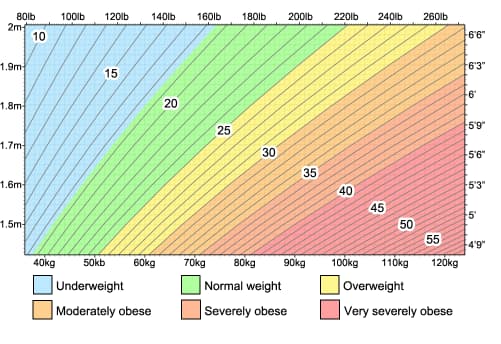
BMI chart for adults
This graph illustrates BMI categories based on data from the World Health Organization. Different colors indicate the main BMI classifications, while the gray contour lines show whole-number BMI values across various height and weight combinations.
BMI table for children and teens, age 2-20
The Centers for Disease Control and Prevention (CDC) provides BMI classification guidelines for children and adolescents aged 2 to 20.
| Category | Percentile Range |
|---|---|
| Underweight | < 5% |
| Healthy weight | 5% – 85% |
| At risk of overweight | 85% – 95% |
| Overweight | > 95% |
Risks associated with being overweight
Being overweight is associated with an increased risk of several serious health conditions. According to the Centers for Disease Control and Prevention (CDC), these risks include:
- High blood pressure
- Elevated levels of LDL cholesterol (commonly known as “bad” cholesterol), reduced levels of HDL cholesterol (“good” cholesterol), and increased triglycerides
- Type 2 diabetes
- Coronary heart disease
- Stroke
- Gallbladder disease
- Osteoarthritis, a joint condition caused by the deterioration of cartilage
- Sleep apnea and other breathing-related disorders
- Certain types of cancer, including endometrial, breast, colon, kidney, gallbladder, and liver cancer
- Reduced quality of life
- Mental health conditions such as depression and anxiety
- Body pain and difficulty performing physical activities
- A higher overall risk of premature death compared to individuals with a healthy BMI
As shown above, excess body weight can lead to numerous adverse and in some cases life-threatening health outcomes. Maintaining a BMI below 25 kg/m² is generally recommended; however, individuals should consult a healthcare professional to determine whether lifestyle changes are necessary to improve overall health.
Risks associated with being underweight
Being underweight can also pose several health risks, including:
- Malnutrition, vitamin deficiencies, and anemia, which can reduce the blood’s ability to carry oxygen
- Osteoporosis, a condition that weakens bones and increases the risk of fractures
- Reduced immune function, making the body more susceptible to infections
- Impaired growth and development, especially in children and adolescents
- Potential reproductive issues in women due to hormonal imbalances, which can disrupt the menstrual cycle; underweight women also face a higher risk of first-trimester miscarriage
- Possible complications during surgery
- An overall higher risk of premature death compared to individuals with a healthy BMI
In some cases, being underweight may indicate an underlying medical condition, such as anorexia nervosa, which carries its own serious risks. It is important to consult a healthcare professional if you or someone you know appears underweight, particularly when the cause is not immediately clear.
Limitations of BMI
While using an online BMI Calculator is one of the most widely used methods for assessing healthy body weight, it is important to recognize its limitations. BMI provides a convenient estimate of weight relative to height, but it does not account for the composition of the body, including the distribution of fat, muscle, and bone. Because people vary widely in body type, muscle mass, and fat distribution, BMI should not be used in isolation. Instead, it is most effective when considered alongside other measures of health, such as waist circumference, body fat percentage, and overall fitness.
In adults:
BMI can be misleading because it measures total body weight rather than distinguishing between fat and lean mass. Several factors can affect its accuracy, including age, sex, ethnicity, muscle mass, fat distribution, and activity level. For example, an older adult who falls within the “healthy” BMI range may still carry an excessive amount of body fat if they are largely inactive, even though their weight appears normal. Conversely, a younger adult with a high proportion of muscle may have a higher BMI that suggests they are overweight, even though their body fat is low and their overall health is excellent. Athletes, particularly those with significant muscle mass such as bodybuilders, may be classified as overweight or even obese by BMI standards, despite being at a healthy weight for their body composition.
According to the CDC, several general trends are observed in adults:
- Older adults often have higher body fat percentages than younger adults at the same BMI.
- Women typically have more body fat than men with the same BMI.
- Highly muscular individuals may appear to have a high BMI due to increased muscle mass rather than excess fat.
In children and adolescents:
Similar limitations apply when using BMI to assess weight in children and adolescents. In addition to body composition, growth, height, and the stage of sexual maturation can significantly influence BMI. For obese children, BMI is generally a reliable indicator of excess body fat. However, for children who are merely overweight, a higher BMI could result from increased fat or increased fat-free mass, which includes muscles, bones, organs, and water. In thinner children, variations in BMI often reflect differences in lean mass rather than fat. Therefore, while BMI can provide useful guidance, it should be interpreted in the context of growth charts, developmental stage, and other health indicators.
Despite these limitations, BMI remains a fairly accurate indicator of body fat for approximately 90–95% of the population. When used together with other measurements and health assessments, BMI can be a valuable tool for identifying individuals who may be at risk for weight-related health issues and for guiding discussions about healthy lifestyle choices. It is important to remember that no single measure can fully capture overall health, and BMI should be considered one component of a comprehensive evaluation of an individual’s well-being.
BMI formula
The following formulas are used to calculate BMI in both the International System of Units (SI) and the U.S. customary system (USC), illustrated here using an example of a person who is 5’10” tall and weighs 60 pounds:
| USC Units: |
| BMI = 703×mass (lbs)height² (in) (in) = 703×160702 = 23.0 |
| SI, Metric Units: |
| BMI = mass (kg)height2 (m) = 72.571.7782 = 23.0 |
BMI Prime
MI Prime is a measure that compares a person’s BMI to the upper limit of what is considered a “normal” BMI, as defined by organizations such as the World Health Organization (WHO) and the Centers for Disease Control and Prevention (CDC). While this upper limit may vary in certain regions, including some Asian countries, it is generally taken as 25 kg/m², referred to here as BMI<sub>upper</sub>.
The BMI Prime is calculated using the formula:
Since BMI Prime is a ratio of two BMI values, it is a dimensionless number. This value provides a simple way to classify weight status:
- Underweight: BMI Prime < 0.74
- Normal weight: BMI Prime 0.74 – 1.0
- Overweight: BMI Prime > 1.0
- Obese: BMI Prime > 1.2
| Classification | BMI (kg/m²) | BMI Prime |
|---|---|---|
| Severe Thinness | < 16 | < 0.64 |
| Moderate Thinness | 16 – 17 | 0.64 – 0.68 |
| Mild Thinness | 17 – 18.5 | 0.68 – 0.74 |
| Normal | 18.5 – 25 | 0.74 – 1 |
| Overweight | 25 – 30 | 1 – 1.2 |
| Obese Class I | 30 – 35 | 1.2 – 1.4 |
| Obese Class II | 35 – 40 | 1.4 – 1.6 |
| Obese Class III | > 40 | > 1.6 |
BMI Prime enables a rapid evaluation of how an individual’s BMI compares to the upper threshold of the normal range. It also facilitates comparisons across groups with varying upper BMI limits.
Ponderal Index
The Ponderal Index (PI) is a metric similar to Body Mass Index (BMI) in that it assesses a person’s body leanness or corpulence based on their height and weight. Both measures provide a way to gauge whether an individual’s body composition falls within a healthy range, but they differ in how height is incorporated into the calculation. Specifically, the PI uses the cube of the height, rather than the square of the height as in BMI. This distinction makes the PI particularly useful in cases where height extremes can distort BMI values.
While BMI is widely used for evaluating populations and can give a quick general sense of overweight or underweight trends in groups of people, it is less accurate for assessing individuals, especially those at the very tall or very short ends of the height spectrum. In such cases, BMI can overestimate or underestimate body fat levels. The Ponderal Index addresses some of these limitations because the cubing of height in its formula better accounts for variations in body proportions. As a result, PI can provide a more reliable estimate of body leanness or corpulence for individuals whose height falls significantly above or below average, where BMI might give misleading results.
The formulas for calculating PI are straightforward, and it can be expressed in either USC (inches and pounds) or SI (metric) units. Using an example of an individual who is 5’10” and weighs 160 pounds:
USC Units:
SI (Metric) Units:
By comparing PI values rather than BMI alone, researchers and health professionals can gain a more nuanced understanding of body composition, particularly when working with individuals whose heights or weights lie at the extremes. While it is not without its own limitations, the Ponderal Index serves as a valuable complement to BMI, offering a more tailored assessment of body leanness or corpulence in cases where BMI might fall short.
Frequently Asked Questions.
What is a BMI calculator?
An advanced BMI Calculator is a digital tool designed to help you instantly estimate your Body Mass Index (BMI) by entering your weight and height. It provides a quick way to assess whether your weight falls within a healthy range relative to your height. BMI calculators are widely available online and can use either metric (kilograms and meters) or imperial (pounds and inches) units.
How do I calculate my BMI?
You can calculate your BMI using a simple formula:
- Metric units:
- USC/Imperial units:
For example, a person who is 70 inches tall and weighs 160 pounds would have a BMI of:
What is the BMI?
BMI (Body Mass Index) is a number calculated from a person’s weight and height that provides a simple measure of whether an individual is underweight, normal weight, overweight, or obese. While it doesn’t directly measure body fat, it is a useful screening tool for population-level health assessments.
What is a normal BMI?
A normal BMI typically ranges from 18.5 to 24.9. Values below 18.5 are considered underweight, 25–29.9 as overweight, and 30 or above as obese. These ranges help indicate potential health risks related to weight, though individual factors like muscle mass and body composition should also be considered.
What is BMI and its formula?
BMI, or Body Mass Index, is a numerical value that estimates body fat based on height and weight. Its formula depends on the units used:
- Metric formula:
- USC/Imperial formula:
This value helps assess whether a person’s weight is within a healthy range for their height.
Disclaimer: This BMI Calculator provides estimates for informational purposes only and should not be used as a substitute for professional medical advice, diagnosis, or treatment. Always consult a healthcare provider.